Here is a thesis I keep testing against my own nights-and-weekends assistant work: conversation is a separate engineering stratum from intelligence, and progress in one does not produce the other.
The three problems that consume most of my time building a voice assistant have nothing to do with how smart the model is. Whether a person has finished speaking or is mid-thought. Whether an utterance was addressed to the assistant at all, or to someone else in the room. Who holds the floor when there are two people and one assistant, and when the assistant may take it. You can swap in a model twice as capable and every one of these problems survives, untouched, because none of them is a question about language. They are questions about the room.
If that thesis is wrong, then a sufficiently large jump in model quality should move these problems. WWDC 2026 delivered exactly that jump, on-device, and it moved none of them.
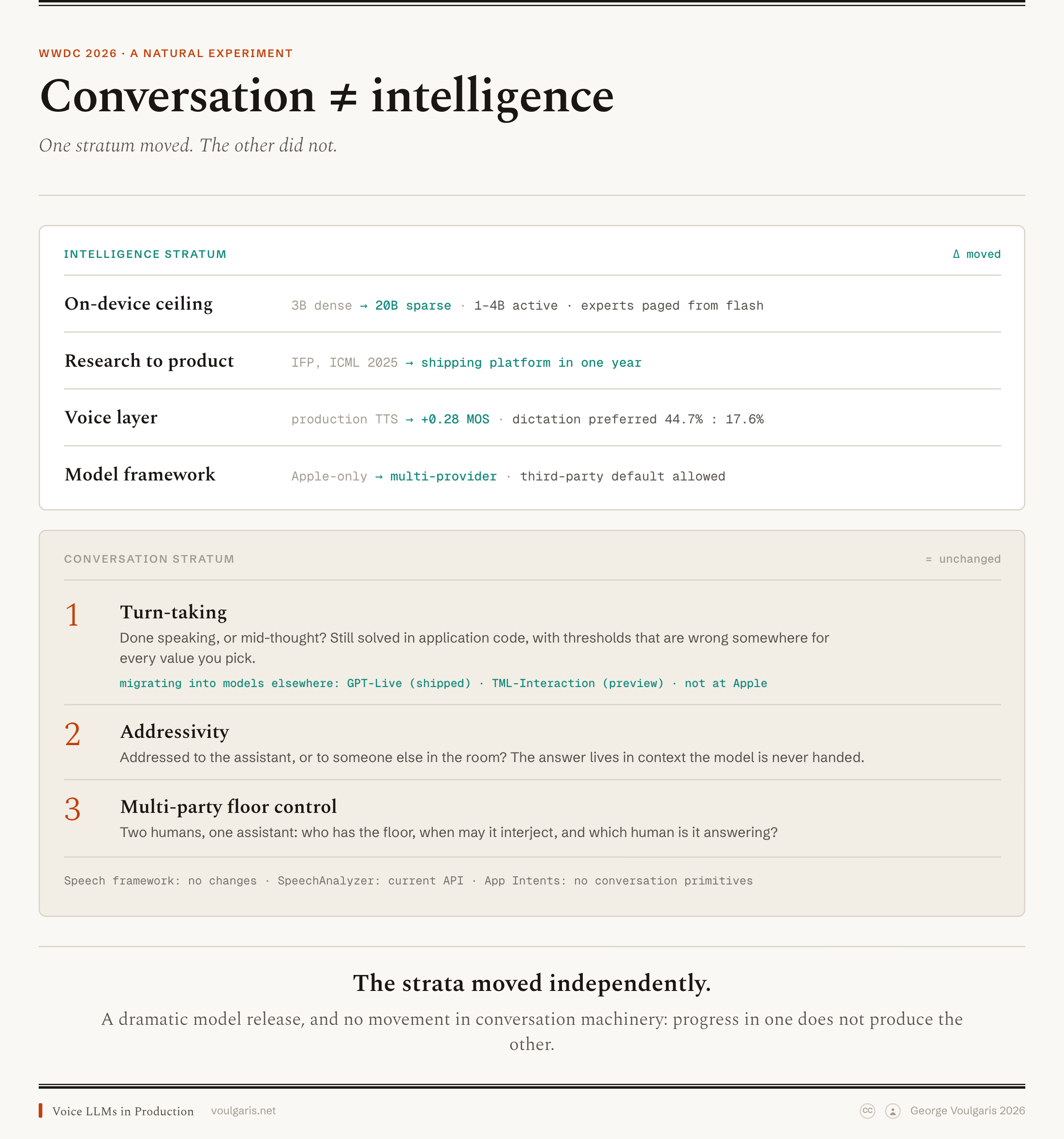
Fig. 1: WWDC 2026 as a natural experiment. The intelligence stratum moved; the conversation stratum did not. Image by author.
Observation: the intelligence stratum moved
Let me be clear that the model progress is real, because the thesis doesn't work if the experiment is weak. Apple's third-generation Foundation Models include AFM 3 Core Advanced, a 20-billion-parameter sparse model that runs on the phone by "activating just 1 to 4 billion parameters at a time." The routing is per-prompt: "a lightweight, dense block selects a fixed set of experts during initial processing, periodically reselecting them during generation," with the full model held in flash storage and weights "loaded incrementally across requests of varying difficulty." The prompt decides how much model you get. Phones stopped gaining meaningful DRAM years ago; Apple routed around the ceiling through flash.
The technique underneath, Instruction-Following Pruning, went from ICML 2025 paper to shipping platform in a year: a mask predictor "takes the user instruction as input and dynamically selects the most relevant model parameters for the given task," and in the paper a 3B-activated model beats its dense twin by 5 to 8 absolute points while approaching 9B quality at 3B latency.
The voice layer moved too. Core Advanced's text-to-speech gained 0.28 Mean Opinion Score over the production baseline; its dictation was preferred 44.7 percent to 17.6. The Foundation Models framework went multi-provider (Apple's models, Claude, Gemini, or your own endpoint behind one API), App Intents gained schemas that wire apps into the new Siri, and users can set a third-party AI as their default.
So: dramatically better intelligence, better voices, better transcription, a rebuilt assistant on the way. If conversation fell out of intelligence, this is the release where it would have fallen out.
…and the conversation stratum did not
The Speech framework remained unchanged; SpeechAnalyzer is still the current API. Nothing anywhere in the platform stack touched the three problems:
Turn-taking. Deciding when a person is done versus thinking is still solved in application code with voice-activity thresholds that are wrong somewhere for every value you pick. I re-tune mine embarrassingly often. This is the one of the three that is genuinely migrating into models elsewhere: OpenAI's GPT-Live went full-duplex this month, listening while it speaks; speech vendors now ship model-based end-of-turn detection; and Thinking Machines builds its interaction models full-duplex from the architecture up, processing the conversation in 200-millisecond micro-turns instead of waiting for you to finish. Which sharpens the point rather than blunting it: even the problem the whole industry is moving into the model didn't move at Apple.
Addressivity. Was that utterance for the assistant, or for the other person in the room? I ended up building a wake-name gate and explicit private/public input modes into my own assistant, because nothing at the platform level answers this. And here's why no model upgrade alone will: the answer lives in context the model is not handed. Which app is foregrounded, where the user is looking, who is enrolled on this device, who else is speaking. The OS has all of it; my application code and the model have almost none of it. (Thinking Machines would object that you can hand the model the room: its interaction models stream audio and video together, micro-turn by micro-turn. Maybe. That experiment is running now, and I come back to it below.)
Multi-party floor control. Two humans, one assistant: who has the floor, when may it interject, and which human is it answering? This one is still on my whiteboard rather than in my code, and I would happily delete the whiteboard if the OS owned the problem. Same structural argument: floor state is room state, not language state.
That's the experiment's result. The intelligence stratum leapt. The conversation stratum, the machinery that makes a voice exchange behave like a conversation rather than a transcription pipeline, stayed exactly where it was: application-developer homework. I've made the broader argument before, that voice conversation is not text chat with audio bolted on; WWDC 2026 is the cleanest single data point I've seen for it, precisely because everything else moved.
What would falsify this
Two things to watch:
- If conversation primitives, turns, addressees, floor state, ever appear in App Intents schemas or a Speech framework successor, Apple has decided this is the OS's stratum after all, and the thesis holds with the ownership question answered.
- Thinking Machines, which argues the opposite ownership position in so many words: "for interactivity to scale with intelligence, it must be part of the model itself." Its interaction models are the live counter-experiment, audio and video streamed through the model in 200-millisecond micro-turns, dialog management handled natively, no external turn-taking harness. If that program ships and handles addressivity and floor control well in the wild, the ownership half of my thesis is wrong: the room moved into the model. But notice what its own framing concedes: Most existing AI models bolt on interactivity with a harness […] Interactivity, in its telling too, is something you must build; it does not fall out of intelligence. On the core claim, the lab attacking the conversation stratum most aggressively agrees with me.
The open question is only who owns the machinery: the OS, the application, or the model. The ecosystem of voice SDKs that handles this today is the application answer, productized.
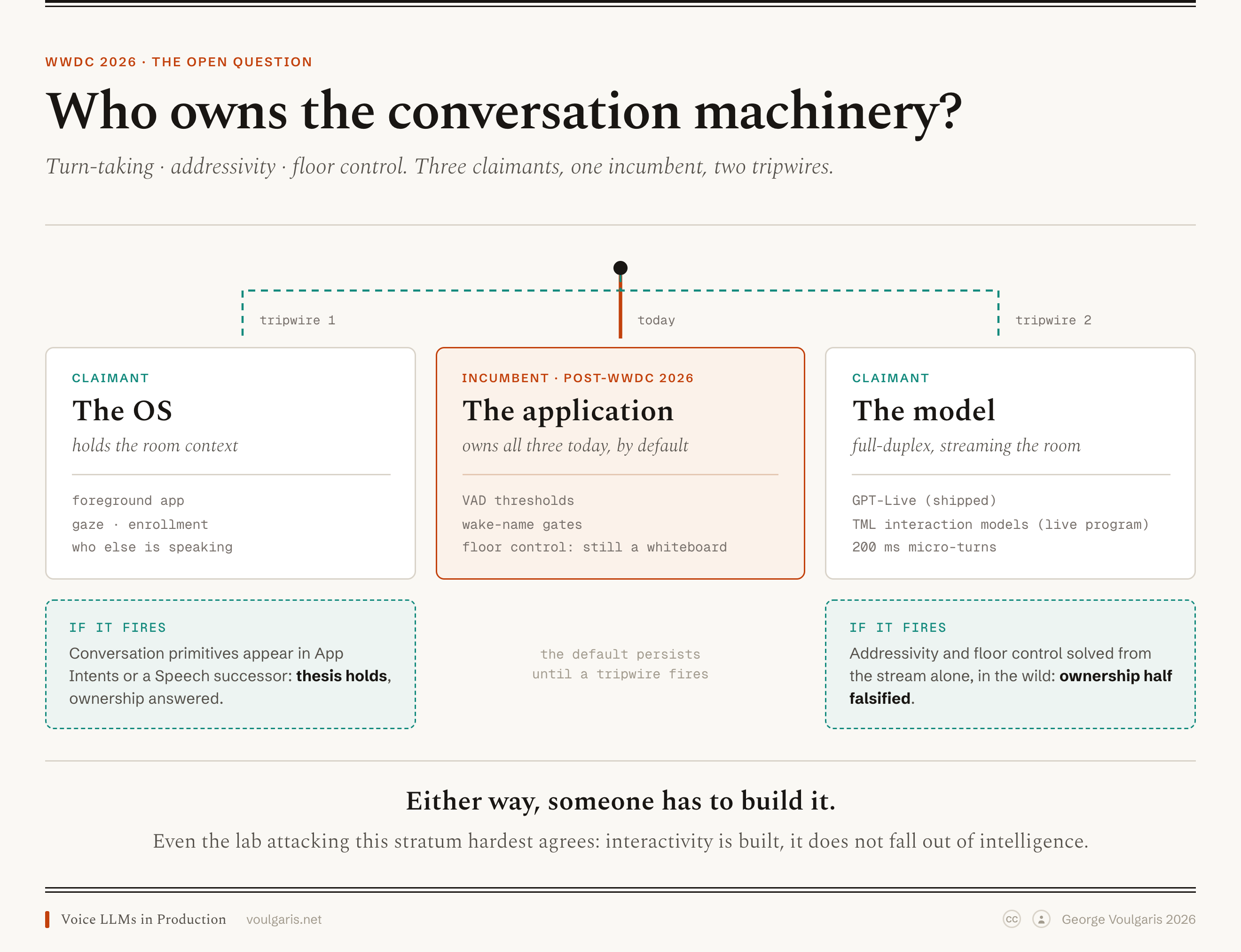
Fig. 2: Who owns the conversation machinery? The incumbent application, the two claimants, and the tripwires that would settle the question. Image by author.
Meanwhile the ceiling moved. A 20B-class sparse model paging experts in from flash means the era of "on-device models are toys" is ending.
The intelligence is arriving on the device. The conversation is still ours to build.
— George · voulgaris.net